
Key Takeaways:
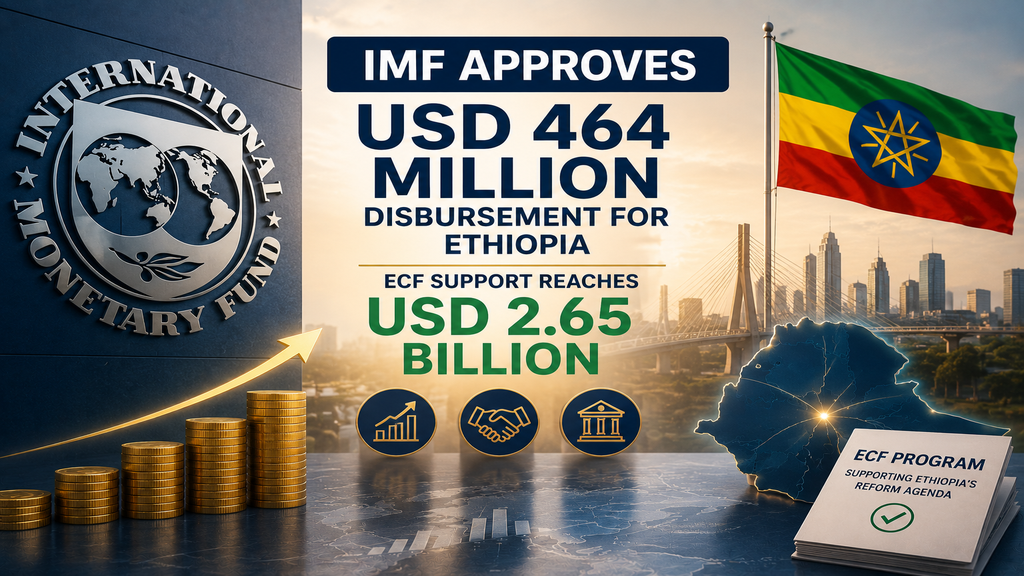
• USD 464m — IMF approved immediate disbursement after Ethiopia’s fifth ECF review.
• USD 2.647bn — total IMF disbursements under the programme since July 2024.
• SDR 342.05m — approved disbursement amount under the 48-month ECF arrangement.
• USD 200m — IMF agreed to rephase funds for earlier access.
• USD 3.4bn — Ethiopia’s ECF arrangement supports the Homegrown Economic Reform Agenda.
• IMF said Ethiopia met all quantitative performance criteria and most indicative targets.
• NBE reforms include easing FX restrictions, expanding interbank trading and enforcing open-position limits.
Market Impact:
The IMF approval gives Ethiopia additional external financing for balance-of-payments and fiscal needs while confirming that the Fund views the reform programme as broadly on track. The disbursement comes as imported fuel prices and external financing pressures remain key macroeconomic risks.
The Fund’s assessment points to progress in exports, tax collection, foreign-exchange reserves and debt restructuring. For businesses, the main signals are continued FX-market reform, tighter monetary policy, fuel-subsidy phase-out and fiscal transparency measures.
The programme remains tied to deeper reforms in the foreign-exchange market, monetary policy, financial-sector oversight, central bank governance and debt restructuring. These areas will shape the operating environment for importers, banks, investors and companies exposed to FX access.
Key Numbers:
USD 464m — Immediate IMF disbursement — balance-of-payments and fiscal support
SDR 342.05m — Disbursement amount — IMF accounting value
USD 2.647bn — Total ECF disbursements — support released since July 2024
USD 200m — Rephased programme funds — earlier access for financing pressures
USD 3.4bn — Total ECF arrangement — reform-programme financing envelope
48 months — ECF programme duration — macroeconomic reform timeline
July 2024 — Facility approval date — start of IMF-supported programme
Business Signal:
The IMF’s latest disbursement reinforces Ethiopia’s reform financing path, with FX-market liberalisation, debt restructuring and fiscal adjustment remaining central to macroeconomic stability.