
Key Takeaways:
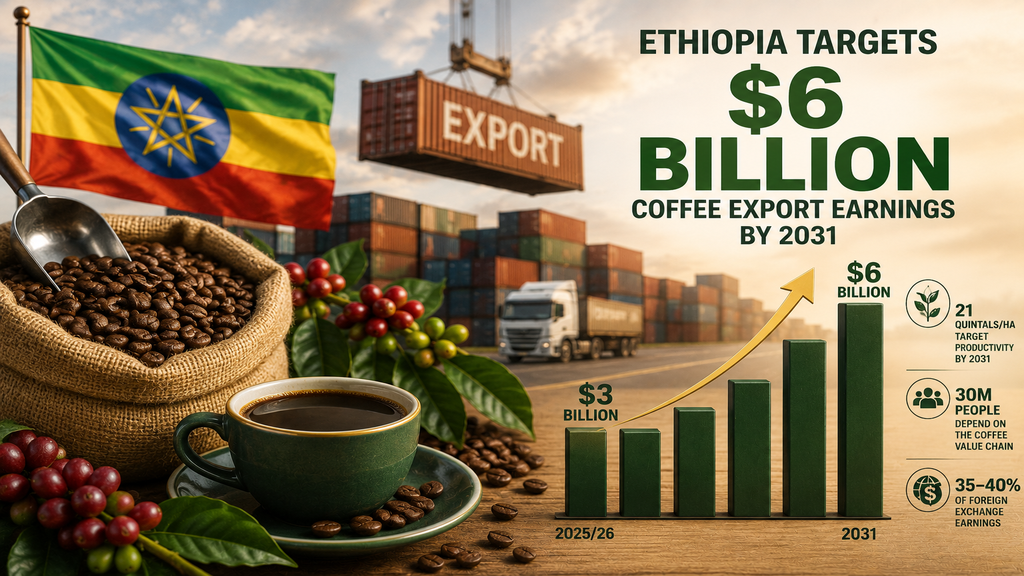
• USD 6bn — Ethiopia targets annual coffee export earnings by 2031.
• USD 3bn — coffee exports reached a record level in the 2025/26 fiscal year.
• June 27 — officials announced the strategy at a Ministry of Agriculture forum.
• 21 quintals/hectare — government targets average coffee productivity by 2031.
• 9 interventions — new national coffee package targets the value chain.
• 30m Ethiopians depend directly or indirectly on the coffee value chain.
• Jimma Agricultural Research Center will host a tissue culture facility for hybrid seedlings.
Market Impact:
Ethiopia’s coffee strategy seeks to convert a record export season into a five-year productivity push. The government is targeting higher yields, better planting density, improved varieties, stronger processing and research support to lift foreign-exchange earnings.
The productivity gap is the central constraint. Ethiopia currently produces 8–9 quintals per hectare, compared with 15 quintals in Brazil and 22–25 quintals in Vietnam, while tree density remains below international averages.
Coffee remains a major macroeconomic sector, contributing 35–40% of foreign-exchange earnings, more than 30% of export revenue and around 4% of GDP. If the new package delivers, it could raise export volumes and strengthen Ethiopia’s position in specialty coffee markets.
Key Numbers:
USD 6bn — 2031 coffee export target — foreign-exchange growth ambition
USD 3bn — 2025/26 coffee export earnings — record baseline
21 quintals/hectare — 2031 productivity target — yield improvement goal
8–9 quintals/hectare — current Ethiopian productivity — production gap
22–25 quintals/hectare — Vietnam productivity benchmark — global comparison
30m people — coffee value-chain dependents — economic exposure
35–40% — coffee share of FX earnings — macroeconomic importance
Business Signal:
Ethiopia is betting that yield improvement and value-chain modernisation can double coffee export earnings while strengthening one of its main foreign-exchange sectors.