
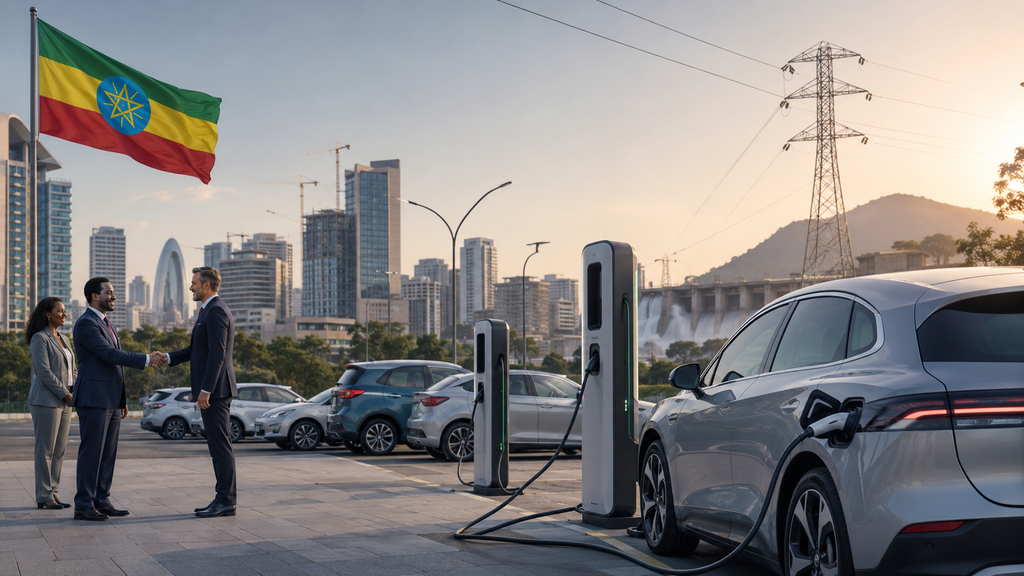
Key Takeaways:
• 115,000 electric vehicles are now on Ethiopian roads, outpacing charging infrastructure capacity.
• Ethiopian Electric Utility signed an MoU with Norwegian-linked Thought Leader Africa AS.
• EEU will cooperate on technical training, institutional capacity building and electric mobility knowledge exchange.
• Ethiopia has about 100 public charging stations, mostly concentrated in Addis Ababa.
• Fuel imports exceed $4bn annually, strengthening the economic case for EV adoption.
• Government plans target roughly 2,300 charging points by 2030.
• Ethiopia’s EV fleet could reach about 500,000 vehicles by 2030 under official projections.
Market Impact:
Ethiopia’s EV transition is moving faster than its supporting infrastructure, creating a widening gap between vehicle adoption and charging availability. The EEU agreement signals that institutional capacity, training and coordination are becoming central to the next phase of the market.
For businesses, the immediate opportunity lies in charging infrastructure, fleet services, technical training and urban mobility systems. But the concentration of charging stations in Addis Ababa shows that the market remains uneven, with regional expansion dependent on grid access and investment coordination.
The link with Norway also positions Ethiopia to use international policy and operational experience as it prepares for the Nordic Africa EV Summit in Addis Ababa in September 2026.
Key Numbers:
115,000 — electric vehicles on Ethiopian roads — shows rapid market adoption
100 — public charging stations — indicates infrastructure gap
2,300 — planned charging points by 2030 — signals infrastructure expansion target
500,000 — projected EV fleet by 2030 — shows future demand scale
$4bn — annual fuel import bill — explains FX and policy pressure
60% — EV share of new car registrations in 2024 — reflects fast adoption
90%+ — hydropower share of electricity generation — supports low-carbon transport case
Business Signal:
Ethiopia’s EV market is shifting from vehicle import growth to infrastructure, grid readiness and institutional coordination.