
Key Takeaways:
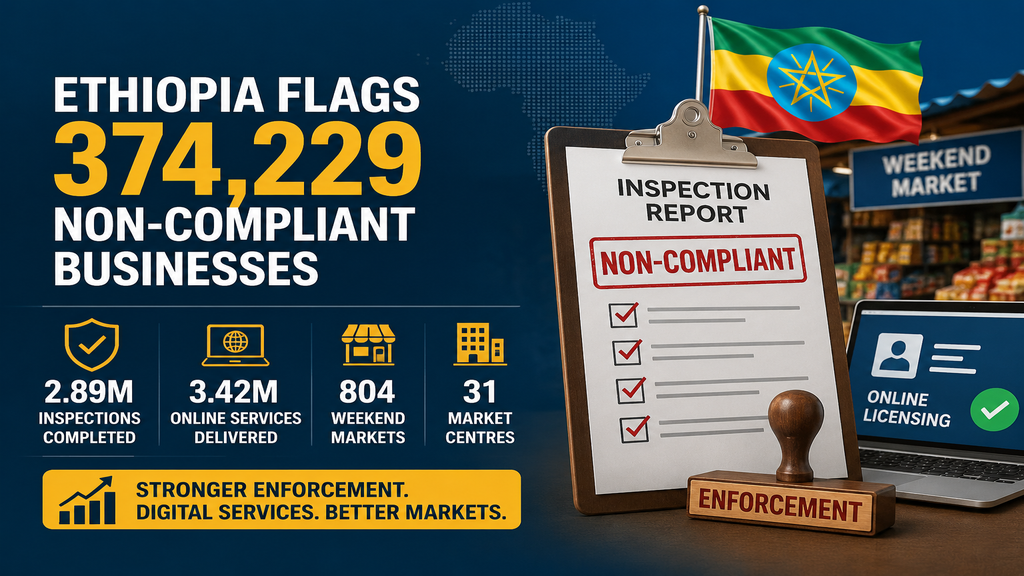
• 374,229 businesses — Ethiopia found this number operating in breach of trade regulations.
• 2.89m inspections — Ministry of Trade completed post-licensing checks during 2025/26.
• 13% — inspected businesses were found non-compliant with legal and regulatory requirements.
• 3.42m online services — business registration and licensing services were delivered digitally.
• 101% — online service delivery exceeded the ministry’s fiscal-year target.
• 804 weekend markets — the ministry facilitated new market infrastructure nationwide.
• 31 second-tier market centers — Ethiopia completed more than triple its original target.
Market Impact:
Ethiopia’s trade authorities are combining stronger enforcement with broader digital service delivery. The Ministry of Trade and Regional Integration’s inspection campaign shows a tighter compliance posture, while the expansion of online licensing points to a parallel effort to reduce administrative friction for formal businesses.
The figures also underline the scale of informality and regulatory breaches in the commercial sector. A 13% non-compliance rate across nearly 2.9 million inspections gives the government a clearer enforcement map as it seeks to formalize business activity and combat illegal trade.
The expansion of weekend markets and second-tier market centers adds a domestic trade-infrastructure dimension. By improving direct links between producers and consumers, the ministry is trying to reduce intermediary pressure while reinforcing consumer protection and market access.
Key Numbers:
374,229 businesses — Non-compliant operators identified — enforcement scale
2.89m inspections — Post-licensing inspections completed — compliance monitoring volume
93% — Inspection target achieved — implementation rate against 3.18m target
3.42m services — Online registration and licensing services — digital service scale
101% — Online service target achieved — exceeded 3.38m target
12% — Online service growth — increase from previous fiscal year
804 markets — New weekend markets established — domestic trade infrastructure expansion
2,365 markets — Nationwide weekend market total — market access footprint
31 centers — Second-tier market centers completed — above original target of nine
Business Signal:
Ethiopia is tightening trade compliance while expanding digital licensing and market infrastructure, signalling a stronger push to formalize commerce and reduce illegal trade.