
Key Takeaways:
• 31.6% — surveyed exporters said they plan to shut down under the tax measures.
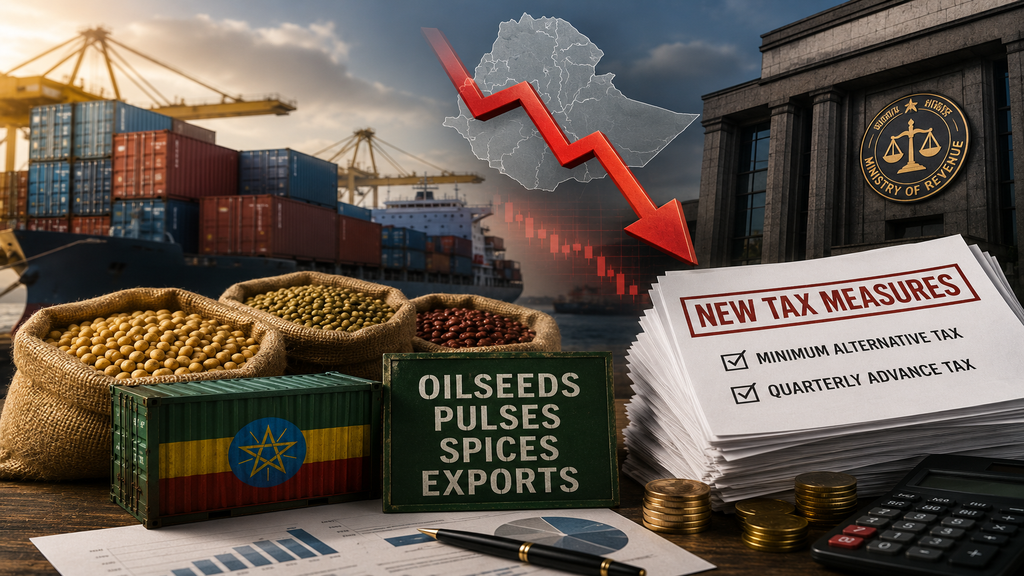
• EPOSEA says minimum alternative tax and quarterly advance tax burden over 500 member companies.
• 87.1% — surveyed members reported a severe liquidity crisis.
• 84.2% — surveyed members said profit margins are shrinking.
• 25% — quarterly advance tax requirement strains exporters before foreign-buyer payments arrive.
• MoTRI officials said the 2.5% levy could cut export revenue and pressure the sector.
• MoR officials rejected sector-specific exemptions and asked loss-claiming firms to justify losses.
Market Impact:
The dispute exposes a widening tension between Ethiopia’s revenue mobilisation drive and one of its key hard-currency-earning export sectors. Pulses, oilseeds and spices exporters argue that turnover-linked and advance tax obligations drain working capital before crops are purchased, processed, shipped and paid for by foreign buyers.
The sector’s financing cycle makes liquidity central to export performance. If companies reduce buying, delay shipments or exit the market, the impact could move beyond firms to smallholder farmers, rural workers, banks and foreign-exchange inflows.
The policy risk is also competitive. Exporters say higher tax pressure could weaken Ethiopia’s position in markets such as China, the United States, Saudi Arabia and Germany, while Trade Ministry officials warned that legitimate firms could be pushed out and contraband networks strengthened.
Key Numbers:
500+ — EPOSEA member companies — affected value-chain base
31.6% — Respondents planning shutdown — operational risk signal
87.1% — Respondents facing severe liquidity crisis — cash-flow pressure
84.2% — Respondents reporting shrinking margins — profitability pressure
31.6% — Respondents expecting price increases — cost pass-through risk
21.1% — Respondents seeking alternative funding — financing pressure
15.8% — Respondents planning workforce cuts — employment risk
2.5% — Levy cited by Trade Ministry officials — export-revenue pressure point
25% — Quarterly advance tax share of annual obligation — upfront cash burden
1,488tn — Pulse, oilseed and spice exports over 11 months — export-volume figure cited
Birr 2.45bn — Agricultural export earnings cited — sector revenue contribution
Birr 333.1m — Manufacturing export earnings cited — comparison category
Birr 3.6bn — Mineral resource export earnings cited — comparison category
Birr 9.4bn — Export target cited for the budget year — national trade target
115% — First-eight-month target achievement claimed by officials — export-performance marker
Birr 100 — Sales example used by MoR official — tax-compliance argument
Birr 30 — State share cited by MoR official — tax-collection position
Business Signal:
Ethiopia’s tax reform is testing the liquidity limits of export sectors that generate scarce foreign currency, making audit-based enforcement and working-capital sensitivity central to policy credibility.