
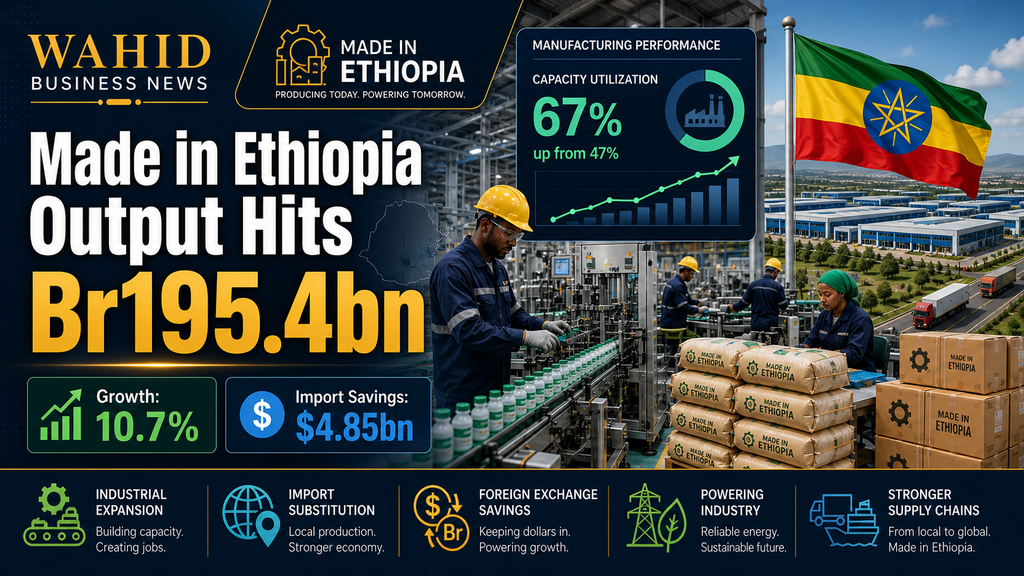
• Br195.4 billion manufacturing output followed sector growth rising from 4.8 percent in 2022 to 10.7 percent in 2025.
• PMO says Made In Ethiopia addressed structural bottlenecks through integrated leadership, policy reforms, and manufacturing competitiveness measures.
• Raw material supply projections rose from 29 million tons to 76 million tons, averaging 15 million tons annually.
• 3.4 GW electric power was commissioned for new investments over four years, supporting industrial expansion.
• Br50 billion credit was projected for SMEs, while large manufacturer financing increased to Br262 billion.
• $2.28 billion foreign currency was channeled to major producers, raising average capacity utilization from 47 percent to 67 percent.
• Import substitution saved over $4.85 billion in foreign currency during 2018’s first nine months.
Market Impact:
Ethiopia’s manufacturing drive is shifting from policy ambition to measurable industrial expansion, with higher output, improved capacity utilization, and larger credit flows supporting producers.
The figures point to a stronger import-substitution agenda, with foreign currency savings and rising local market share becoming central to Ethiopia’s industrial strategy.
For business leaders, the main signal is a manufacturing sector receiving coordinated support through land, power, credit, forex access, and investor attraction.
Key Numbers:
Br195.4 billion — Manufacturing output — Indicates sector expansion.
10.7 percent — Manufacturing growth in 2025 — Shows acceleration from 2022.
$4.85 billion — Import-substitution savings — Reduces foreign currency pressure.
$2.28 billion — Forex channeled to major producers — Supports industrial capacity.
2,800+ investments — Attracted over four years — Signals investor pipeline growth.
18,000+ SMEs — Small and medium industries established — Expands domestic production base.
993 factories — Closed factories revived — Restores productive capacity.
Business Signal:
Ethiopia is using manufacturing policy, forex allocation, credit expansion, power supply, and land delivery to deepen domestic production capacity.