
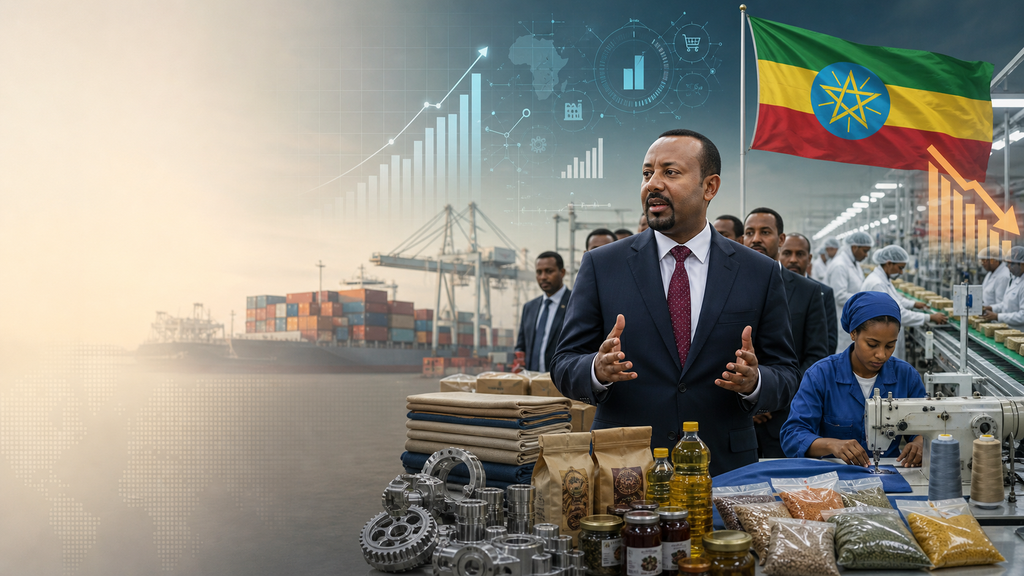
•USD 14.5 billion in import bills was saved through locally manufactured goods over four years.
• Prime Minister Abiy Ahmed praised import substitution at the fourth Made in Ethiopia Expo.
• USD 3.5 billion was reportedly saved annually over the past four years.
• Ethiopia’s annual import bill has hovered near USD 17 billion for several years.
• USD 8.3 billion in export revenue was reported last year, Ethiopia’s highest ever.
• Manufacturing exports reached only USD 97 million in the first quarter of the fiscal year.
• Close to 1,000 previously shuttered factories resumed operations during the period.
Market Impact:
Ethiopia’s import substitution drive is being framed as a tool for reducing external payment pressure, with the government citing USD 14.5 billion in avoided imports over four years. For business leaders, the key issue is whether revived factory activity can translate into sustained output, lower import dependence, and stronger domestic supply capacity.
The trade balance remains the central pressure point. The article notes that annual imports remain near USD 17 billion, while last year’s export revenue reached USD 8.3 billion, leaving a trade deficit typically above USD 10 billion.
Manufacturing remains the weak link in the export story. The sector generated only USD 97 million in first-quarter exports despite access to foreign exchange for machinery, inputs, and spare parts, underlining the gap between industrial policy ambition and export performance.
Key Numbers:
USD 14.5 billion — Import bills saved over four years — Measures scale of import substitution claim
USD 3.5 billion — Annual savings over four years — Indicates recurring import-reduction target
USD 17 billion — Ethiopia’s annual import bill — Shows external payment pressure
USD 8.3 billion — Last year’s export revenue — Marks Ethiopia’s highest reported export figure
USD 97 million — First-quarter manufacturing exports — Shows limited export contribution
1,000 factories — Previously shuttered factories reportedly resumed operations — Signals industrial capacity recovery
May 3, 2026 — Fourth Made in Ethiopia Expo opening — Marks policy messaging event
Business Signal:
Ethiopia’s import substitution policy is gaining political momentum, but manufacturing’s low export contribution remains the main test for industrial credibility.