
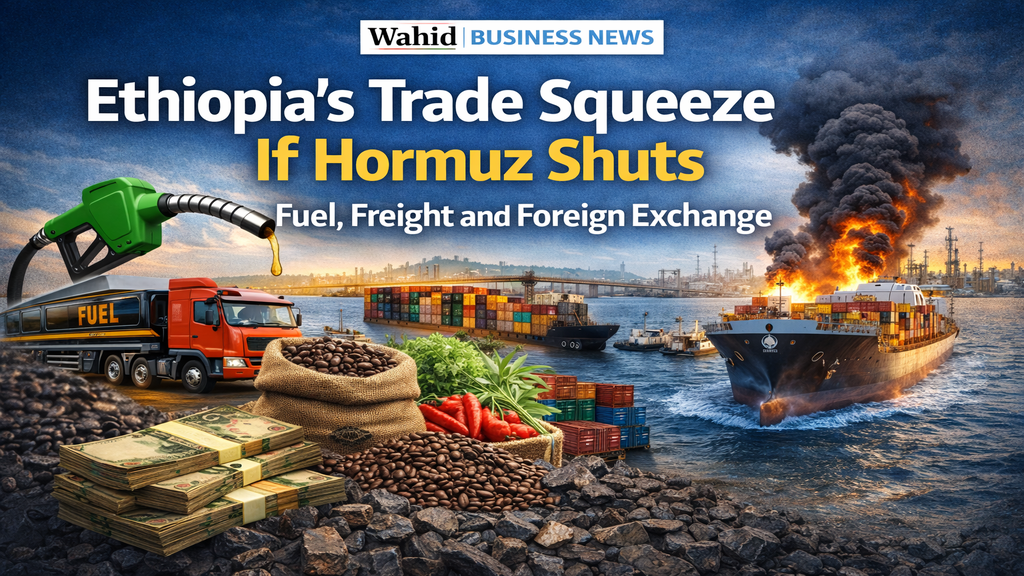
A credible threat to close the Strait of Hormuz has moved from long-running risk to near-term market shock. Iran publicly declared the strait closed and threatened vessels attempting transit, after U.S. and Israeli strikes and subsequent regional escalation. ( Reuters) Major maritime insurers have moved to cancel or restrict war-risk cover for Gulf voyages from early March, while shipowners pause sailings and reroute. ( The Guardian)
For Ethiopia, the transmission channel is not direct shipping through Hormuz—Ethiopia is landlocked—but the pricing, availability and logistics of imports and exports that depend on global energy flows and Middle East maritime risk.
Why Hormuz matters to Ethiopia even without a coastline
The Strait of Hormuz is the world’s most important oil chokepoint. The U.S. Energy Information Administration estimates oil flows through Hormuz averaged about 20 million barrels per day in 2024, roughly 20% of global petroleum liquids consumption. ( U.S. Energy Information Administration) When that corridor is perceived to be closed—or becomes effectively unusable due to attacks and insurance withdrawal—global benchmark prices can gap higher, physical cargo availability tightens, and shipping premiums rise.
The second-order effects are now visible. Insurers’ war-risk decisions and vessel stoppages reduce effective tanker supply and push up freight and insurance costs. ( The Guardian) Those costs ultimately land in the delivered price of refined products and other imports to East Africa, including through Red Sea approaches already exposed to elevated security risk since late 2023. ( Reuters)
Fuel: the first and largest shock absorber
Ethiopia’s exposure starts with fuel. Transport, agriculture logistics, and manufacturing all price off imported petroleum. When global supply risk spikes, Ethiopia’s fuel import bill can rise even if volumes do not.
Two domestic features amplify the hit:
High and rising fuel consumption. Ethiopia’s petroleum demand has been expanding with transport and construction activity; reported import volumes for gasoline and white diesel in FY2024/25 were significant (including millions of tonnes of diesel). ( The Reporter Magazine)
Balance-sheet pressure at the state fuel chain. Recent reporting indicates the state fuel importer has faced large losses and cash-flow strain tied to FX and pricing dynamics—making sudden global price jumps harder to absorb without either higher pump prices, higher subsidies, or arrears in the supply chain. ( birrmetrics.com)
If Hormuz disruption persists, Ethiopia’s most immediate risks are:
Higher landed cost of fuel (oil price + tanker freight + war-risk insurance + longer routing). ( The Guardian)
Supply intermittency if cargoes are delayed, rescheduled, or sellers invoke higher risk premia. ( The Guardian)
FX demand pressure as fuel is typically among the most FX-intensive import categories; higher prices increase hard-currency requirements for the same volumes. (This is a mechanical balance-of-payments effect, not a forecast.)
Freight and insurance: the hidden tax on all imports
Even beyond energy, a Gulf security shock behaves like a tax on trade.
War-risk cover withdrawal and premium jumps raise voyage costs and reduce vessel availability. The Guardian reported insurers cancelling cover and premiums potentially rising sharply, alongside widespread vessel halts. ( The Guardian)
Container and dry bulk rates can move quickly when ships detour, port calls change, and equipment repositioning breaks. UNCTAD has documented how rerouting and security risks contributed to freight volatility during recent disruptions. ( UN Trade and Development (UNCTAD))
Supply chains stack risks: Red Sea insecurity already reduced Suez trade flows materially in early 2024, with knock-on effects on transit times and costs. ( IMF) A Hormuz shock adds a second chokepoint premium into the same broad theatre (Gulf–Arabian Sea–Red Sea approaches).
For Ethiopian importers, the practical outcomes are typically:
Longer lead times for machinery, spare parts, chemicals, fertilizers, and consumer goods shipped via transshipment hubs in the Gulf. ( The Guardian)
Higher CFR/CIF prices as freight and insurance are embedded in supplier quotes.
Greater inventory financing needs because longer transit ties up working capital.
Exports: payment risk and demand softening through the Gulf channel
Ethiopia’s exports (coffee, oilseeds, horticulture, livestock and others) face two relevant risks if Hormuz is closed or effectively closed:
Middle East demand and logistics risk. Gulf economies and the wider region are significant trading counterparts for Ethiopia. Any regional slowdown or logistics disruption can reduce orders, delay payments, or increase rejection/quality risk for time-sensitive cargo. (Directionally true; magnitude depends on sector and contract terms.)
Transshipment friction. If Jebel Ali and other Gulf hubs face higher freight costs and scheduling disruptions, East Africa-bound container rotations can be cut or repriced. The Guardian reported sharp freight moves on Asia–Gulf lanes in the immediate shock window. ( The Guardian)
The “double chokepoint” problem for Ethiopia: Gulf risk plus Red Sea risk
The worst case for Ethiopian traders is not a single disruption but a compounded routing problem: elevated risk in the Gulf (Hormuz) alongside renewed attacks risk in the Red Sea and Gulf of Aden. Reuters explicitly notes markets were already strained by Red Sea disruptions when Hormuz risk escalated. ( Reuters)
That matters for Ethiopia because its external trade is structurally concentrated through the Djibouti corridor. Any global shock that raises the cost of shipping into the Red Sea basin, or reduces vessel supply willing to serve it, shows up quickly in local landed prices and availability.
What Ethiopian businesses should watch next
In the next days to weeks, Ethiopia’s importers and exporters should track a small set of market indicators that translate geopolitics into invoices:
Brent crude and refined product cracks (diesel/gasoline differentials) for pass-through into fuel pricing.
War-risk insurance notices and any reinstatement/expansion of cover for Gulf voyages. ( The Guardian)
Tanker and container freight indices on Asia–Middle East and Middle East–East Africa legs. ( The Guardian)
Operational status statements from major shipowners and energy agencies monitoring traffic halts and supply contingencies. ( S&P Global)
Bottom line for Ethiopia’s import/export market
A Hormuz closure is not just an oil story; it is a delivered-price story. For Ethiopia, the near-term impact would likely concentrate in fuel costs, then spread through freight and insurance into almost every imported input—transport, construction, agriculture, manufacturing—while also raising logistics friction for exports. The severity depends on duration: a brief disruption mainly raises spot prices and freight premia; a prolonged closure forces rerouting, sustained insurance constraints, and higher FX requirements for essential imports. ( The Guardian)