
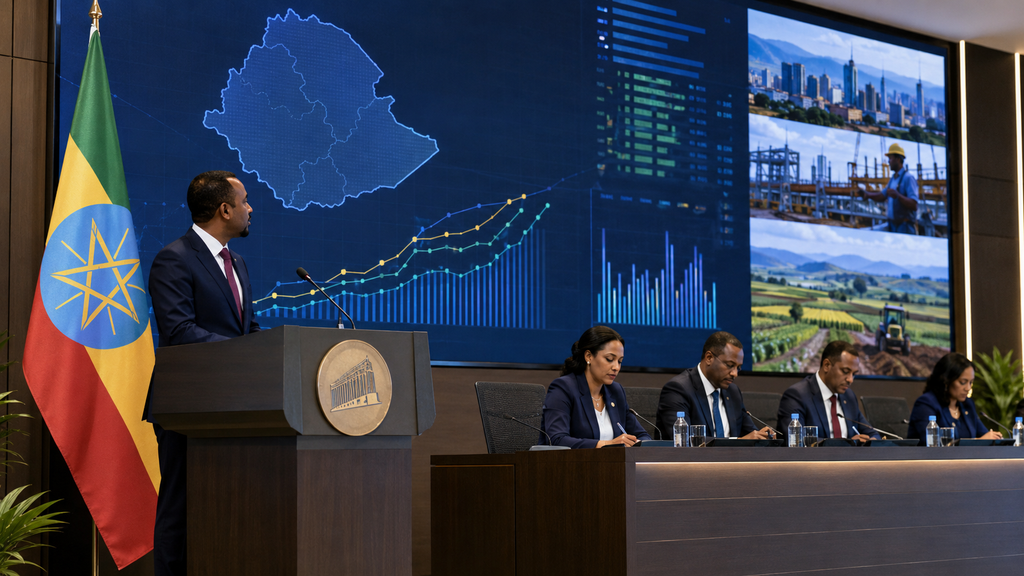
Key Takeaways:
• September 2026 deadline set for Ethiopia’s GDP rebasing exercise.
• Ministry of Planning and Development will adopt 2017 E.C. as the new GDP base year.
• Services account for about two-fifths of GDP, making them Ethiopia’s largest sector.
• Industry contributes roughly one-quarter of output, supported by construction and manufacturing expansion.
• Agriculture’s share has declined but remains significant at just over one-third of GDP.
• Regional GDP accounting will be included, with test estimates from regional states already finalised.
• CPI reform will update consumption baskets, geographic coverage and market outlet inclusion.
Market Impact:
The GDP rebasing will alter how Ethiopia measures national output, regional production and sectoral performance. For policymakers, investors and analysts, the change could reshape assessments of growth, productivity and the relative weight of services, industry and agriculture.
The reform also signals a broader effort to centralise and standardise economic data under the Statistical Development Program. Stronger administrative datasets, including formal and informal business registration, could improve fiscal planning and policy design.
The next phase, including CPI reform and welfare measurement, will be important for inflation analysis, household consumption tracking and outcome-based policy evaluation.
Key Numbers:
September 2026 — GDP rebasing deadline — new national accounts benchmark
2017 E.C. / 2024-25 — new base year — updated GDP calculation reference
2015/16 — current GDP base year — existing benchmark to be replaced
About two-fifths — services share of GDP — largest sector weight
Roughly one-quarter — industry share of GDP — construction and manufacturing contribution
Just over one-third — agriculture share of GDP — declining but significant output base
3 years — Statistical Development Program activity period — reform implementation timeline
Business Signal:
Ethiopia is moving to update its economic measurement system, with implications for GDP analysis, sector planning, inflation tracking and investment assessment.