
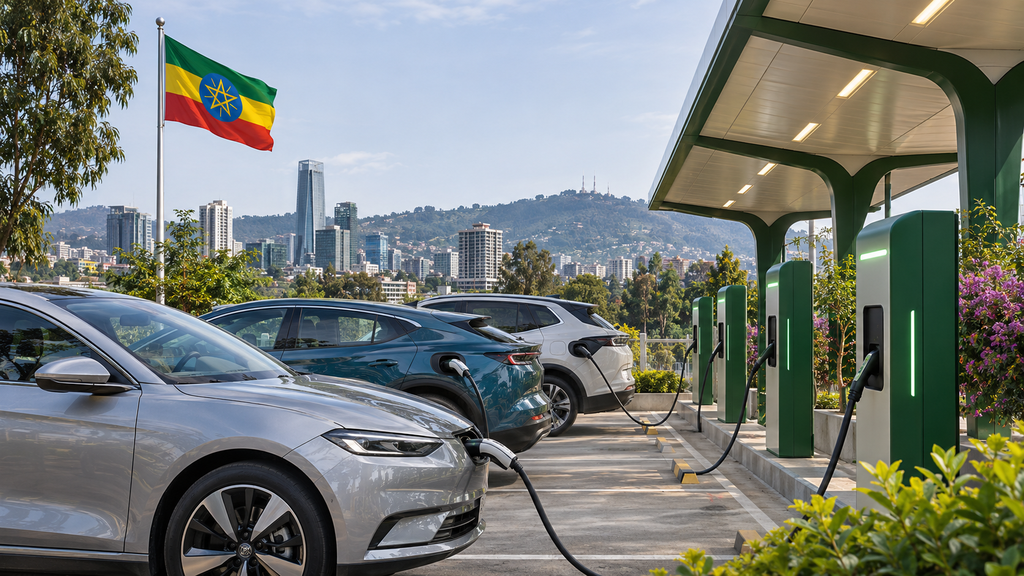
Thumbnail: editorial illustration.
Key Takeaways
• 11 new charging stations bring Ethiopian Electric Utility’s operational network to 14 sites.
• About 150 vehicles can charge simultaneously across the utility’s operational network.
• 96 vehicles can use the new stations simultaneously, versus more than 54 at earlier Addis Ababa sites.
• 1,176 stations are needed in Addis Ababa alone, according to the utility’s demand estimate.
• $10 million is the estimated cost of a 40-station first phase: 32 in Addis Ababa and eight elsewhere.
• More than 10 additional stations are under construction, with further regional expansion planned.
• EEU and three Chinese partners will assess grid capacity for Ethio-Djibouti heavy-truck charging through a six-month study.
Market Impact
The additions extend charging services across Addis Ababa, Bishoftu, Mojo, Adama, Batu and Hawassa. Time-of-use tariffs differentiate overnight, daytime and peak charging costs. EEU links expansion to reducing fuel imports and foreign-currency spending through renewable electricity.
The utility’s station-demand estimate indicates a substantial infrastructure requirement. Fleet estimates remain inconsistent: EEU reports nearly 140,000 EVs entering Ethiopia, while the transport ministry has been cited as estimating over 140,000 in Addis Ababa alone. These figures should not be treated as a reconciled fleet total.
Heavy-truck charging remains at the feasibility stage. EEU, Huawei, China Road and Bridge Corporation and Beijing Forever Technology will study grid readiness for charging points that could each require several megawatts.
Key Numbers
• 14 stations — operational EEU network — current service footprint.
• About 150 vehicles — simultaneous charging capacity — network throughput measure.
• 14.85 birr/kWh — approximate overnight tariff — lowest stated charging rate.
• 16.57 birr/kWh — approximate daytime tariff — daytime energy cost.
• 18.28 birr/kWh — approximate peak tariff — highest stated charging rate.
• 40 stations — first-phase target — planned network scale.
• About $10 million — first-phase cost estimate — investment requirement.
Business Signal
Charging capacity is expanding, while demand estimates and grid-intensive truck charging highlight the scale of further infrastructure needs.