
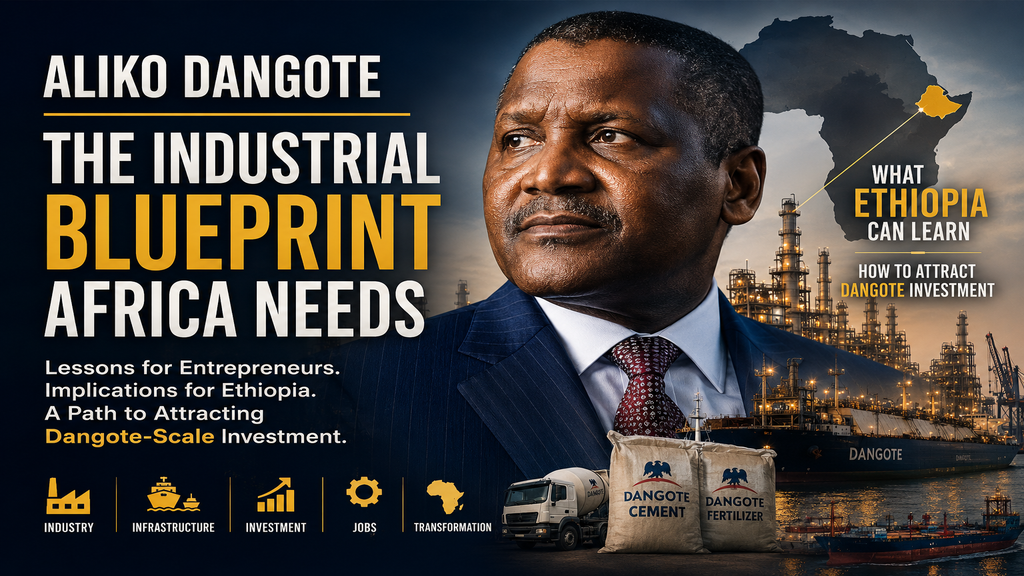
When Aliko Dangote sat down with Nicolai Tangen, chief executive of Norges Bank Investment Management, the conversation was not merely about one billionaire’s rise. It was about the economic architecture Africa still lacks: factories, ports, refineries, patient capital, skilled labour, reliable policy and domestic investors willing to carry risk before foreigners arrive.
Dangote’s central argument was deceptively simple. Africa must produce what it consumes. He described his business method as “backward integration”: identify what a country imports but should be producing, then build the capacity to make it locally. That logic took him from cement trading in Lagos in 1978 to cement plants across 14 African countries, fertiliser, petrochemicals and the world’s largest single-train refinery.
The interview matters because Dangote speaks from inside Africa’s hardest economic problem. The continent does not lack demand. It lacks productive systems. It consumes fuel, cement, fertiliser, plastics, food, machinery and construction materials, but too often imports the processed form while exporting raw value. Dangote’s career is an attempt to reverse that equation.
His refinery is the clearest example. Nigeria produces oil, yet Dangote noted that the country had suffered fuel queues for 52 years. His answer was a $20bn refinery, launched in 2013, built through land delays, currency devaluation, infrastructure shortages, Covid disruption and resistance from entrenched fuel-import interests. At one point, the naira moved from 156 to as low as 1,900 to the dollar during the project cycle, yet the group continued.
That detail matters. African industrialisation is not stopped only by lack of ideas. It is stopped by the brutal practicalities of execution: land, water, roads, ports, finance, currency risk, bureaucracy and political economy. Dangote said the group had to build its own port because Nigeria had no port capable of receiving refinery equipment weighing thousands of tonnes. The site required 440mn litres of treated water and employed 67,000 people during construction.
This is the first real lesson from the interview: in Africa, the industrialist often has to build the ecosystem before building the factory. A refinery is not just a refinery. It is a harbour, road network, water system, training system, financing structure, crude supply chain and political battle.
Dangote was unusually frank about opposition. He described resistance from those benefiting from Nigeria’s fuel subsidy and import system: shippers, traders and local allocation networks that made large profits from the old order. The refinery threatened not only imports but an entire rent-seeking structure around imports.
That is why import substitution is never merely economic. It is political. Every serious African industrial project disturbs someone’s margin. Those who profit from scarcity rarely welcome abundance. Dangote’s story shows that African industry must defeat not only technical difficulty but also the hidden coalition of importers, brokers, officials and financiers whose income depends on the failure of local production.
The second lesson is scale. Dangote’s answer to African scarcity is not small entrepreneurship but industrial magnitude. He spoke of expanding cement capacity to 100mn tonnes, doubling refinery capacity toward 1.4mn barrels per day, building LNG and gas infrastructure, developing a deep port near Lagos, and spending $45bn between 2026 and 2030. His stated target is $100bn in revenue and more than $30bn in EBITDA by 2030.
This is not ordinary African business thinking. Much of African commerce remains trapped in short cycles: import, distribute, collect margin, repeat. Dangote’s model is longer, heavier and riskier. It ties capital to assets that cannot be quickly moved. It requires years before profit. It depends on engineering competence and political stamina. It is capitalism as construction, not arbitrage.
Yet there is nuance. Dangote is not simply an heroic free-market figure. His rise has always existed within state policy, import licensing, protection, infrastructure concessions and political negotiation. He understands that large industry in developing economies is never built by the market alone. It requires a bargain between state and capital. The state provides policy stability, protection against destructive imports and infrastructure support; the industrialist provides jobs, tax revenue, production and strategic goods.
He made this point directly. Governments, he argued, increasingly realise that employment must come from the private sector because the state is already full and lacks the resources to absorb everyone. He framed the relationship as a partnership: companies create VAT, taxes, jobs and production; governments provide good regulation and investment policy.
That is perhaps the most important policy message in the interview. Africa does not need anti-business government. Nor does it need private monopolies without discipline. It needs a developmental bargain: predictable rules, productive investment, tax contribution, local capacity and accountability on both sides.
Dangote’s comments on China were equally revealing. Asked who is helping Africa in business, he answered plainly: China. His explanation was not ideological. China dominates because it arrives with financing, equipment, supplier credit and export insurance. He contrasted this with Western suppliers who may offer good equipment but expect large upfront cash payments. For an African industrialist trying to preserve liquidity and build multiple projects, supplier credit can determine who wins the contract.
This is a serious lesson for Europe, America and Japan. Africa does not only need advice, conferences or ESG language. It needs balance sheets. Dangote’s message to Japan was blunt: if you come, come with financial support. Otherwise African buyers will choose countries that help them “leapfrog to the next level.”
On climate, his answer was more complex than many Western audiences may prefer. He acknowledged climate change as real and said the group is lowering dust emissions, using robotic systems, alternative fuels, CNG trucks, hydro, gas, solar and wind. But he also argued that Africa cannot suspend development in the name of climate policy. It must provide what its people need while reducing environmental harm.
This is the African industrial dilemma in one sentence: decarbonise, but do not deindustrialise before industrialising. Dangote’s argument is not a rejection of climate responsibility. It is a demand for sequencing. Africa’s share of historical emissions is low, but its need for cement, fertiliser, fuel, roads, electricity and factories is enormous.
For African entrepreneurs, the interview offers a difficult lesson. Dangote’s success is not mainly about inspiration. It is about discipline. He repeatedly returned to focus, honesty, reinvestment and knowing one’s business deeply. He said he exited flour and textiles partly because of foreign exchange challenges, and that wholly owned Dangote Industries businesses have not paid dividends out to the parent; profits are reinvested.
The Arsenal anecdote captures the same mentality. Dangote said he considered buying the club when it was worth about $2bn, but chose instead to complete the refinery, fertiliser and petrochemical projects. It is a revealing capital allocation decision: prestige asset or productive infrastructure. He chose the harder, less glamorous option.
This is where many African business elites should feel uncomfortable. Too much capital on the continent moves into real estate, imports, luxury consumption, political contracts and speculative trading. Too little moves into patient productive capacity. Dangote’s model is not easily replicable, but the mentality is: concentrate, reinvest, build capacity, master supply chains and think in decades.
For Ethiopia, the relevance is immediate.
Ethiopia has many of the conditions Dangote described: a large population, unmet demand, import dependence, FX shortages, infrastructure gaps and a young labour force. It also has sectors where import substitution and industrial depth are urgent: fertiliser, agro-processing, cement efficiency, construction materials, packaging, petrochemicals, logistics, transport equipment, spare parts, industrial maintenance and energy-linked manufacturing.
Dangote named Ethiopia among Africa’s promising countries for investment, alongside Nigeria, Kenya, Tanzania, Rwanda, Egypt, Algeria, Ghana, Côte d’Ivoire and others. That should not be read as praise alone. It is also a challenge. Ethiopia has scale, demand and energy potential, but it must convert those advantages into bankable industrial conditions.
The first lesson for Ethiopian businesses is to move beyond import intermediation. Many Ethiopian firms survive by importing finished goods, distributing scarce items or using access to foreign exchange as a competitive advantage. That may be profitable, but it does not build industrial sovereignty. Ethiopia needs business groups that ask Dangote’s question: what are we importing that we should be producing?
The second lesson is vertical integration. Ethiopian industry often fails because one missing input stops the chain: packaging, spare parts, power reliability, customs clearance, working capital, transport or FX. Dangote’s model is to control more of the chain when the surrounding system is weak. Ethiopian industrialists in agro-processing, construction materials, vehicle assembly, chemicals and logistics should think similarly.
The third lesson is dollar-earning capacity. Dangote emphasised that investors worry not only about profit but about whether dividends can be converted and remitted. His answer is export revenue: he said future investors in major group businesses could be paid dividends in dollars because a large share of revenue will come from exports. Ethiopia’s industrial strategy must internalise this. In an FX-constrained economy, the best companies will either save foreign exchange, earn foreign exchange, or both.
The fourth lesson is human capital. Dangote described graduate training, internal academies and a willingness to train people even if they later leave for other companies. Ethiopia’s private sector often complains about skills but invests too little in structured training. Industrialisation requires technicians, plant managers, engineers, welders, drivers, maintenance specialists and disciplined middle managers. A factory is only as strong as its operating culture.
How, then, could Ethiopia attract Dangote-scale investment?
First, policy predictability. Dangote listed civil war and government policy inconsistency among the biggest risks to his group. Ethiopia cannot attract large industrial capital if investors fear sudden regulatory shifts, unpredictable taxation, arbitrary customs treatment or unclear repatriation rules.
Second, foreign exchange credibility. Large investors need assurance that they can import machinery, service debt and repatriate dividends. Ethiopia’s FX shortage is not merely a banking inconvenience; it is an industrial bottleneck. A Dangote-scale investor would require a clear FX framework tied to export earnings, domestic sales, reinvestment obligations and repatriation rights.
Third, logistics. Dangote’s projects repeatedly return to ports, roads and heavy equipment movement. Ethiopia’s landlocked geography makes this even more important. Industrial investment depends on the Djibouti corridor, dry ports, customs efficiency, predictable trucking, railway reliability and regional alternatives. Logistics is not a support function; it is part of the investment proposition.
Fourth, energy reliability. Ethiopia’s power potential is large, but investors need reliable supply, transparent tariffs and credible industrial connections. Cheap electricity that is unreliable becomes expensive. For energy-intensive sectors such as cement, fertiliser, steel, chemicals, agro-processing and assembly, reliability matters as much as price.
Fifth, project preparation. Ethiopia should not invite Dangote vaguely. It should prepare specific, bankable opportunities: fertiliser blending and distribution, agro-industrial inputs, cement and clinker optimisation, logistics terminals, industrial parks linked to ports, petrochemical distribution, packaging materials, and possibly participation in regional fuel supply chains if East African refinery plans advance.
Recent reports show Dangote is considering a major East African refinery, with Reuters citing a possible 650,000-barrel-per-day project in Mombasa. In the interview, he said a refinery in East Africa could serve countries including Ethiopia. Ethiopia should treat this seriously. Even if the refinery is built in Kenya, Ethiopia’s fuel security, logistics planning and regional energy diplomacy would be affected.
Sixth, domestic investors must lead. Dangote’s sharpest observation was that foreign investors are attracted by domestic investors. Ethiopia cannot simply wait for outsiders. It must cultivate credible local industrial champions, clean balance sheets, transparent governance and long-term capital pools. Foreign capital follows proof.
The interview ends with legacy. Dangote said he wants to be remembered as one of those who pioneered Africa’s industrialisation and helped the continent produce what it consumes. This is not modest language, but it is not empty either. It is attached to factories, debt, ports, engineering risk and thousands of workers.
For Africa, the question is whether Dangote remains an exception or becomes a pattern. One billionaire cannot industrialise a continent. But his interview exposes the habits Africa needs: domestic capital willing to invest at scale, governments willing to provide predictable policy, foreign partners willing to finance production rather than merely sell goods, and entrepreneurs willing to build in sectors that are difficult precisely because they matter.
For Ethiopia, the choice is similar. The country can remain a large market that imports what it consumes. Or it can become a serious industrial economy that produces more of what it needs, earns more of the foreign exchange it spends, and builds companies patient enough to survive the hard years between ambition and output.
Dangote’s message is not that Africa lacks opportunity. It is that opportunity is useless without execution. Potential is not cement. Potential is not fertiliser. Potential is not fuel. Potential is not a port, a refinery, a trained engineer, a working road or a reliable power supply. Africa’s future will belong not to those who speak most beautifully about transformation, but to those who build the difficult things without which transformation remains only a slogan.