
Key Takeaways:
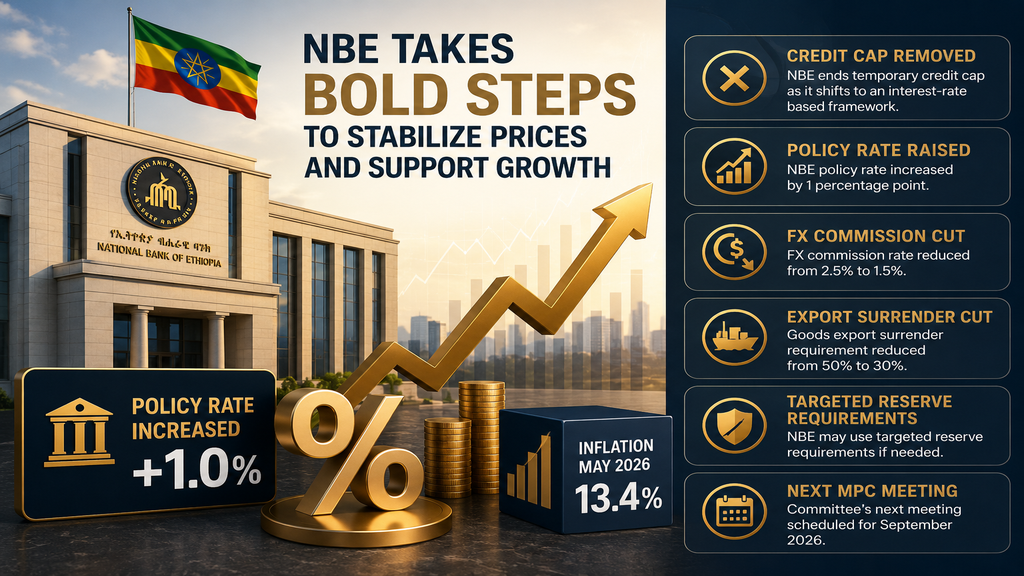
• 1 percentage point — NBE raised its policy rate while keeping the ±3 percentage-point band.
• NBE fully removed the credit cap after saying the temporary measure achieved its objective.
• 13.4% — headline inflation reached a nine-month high in May 2026.
• 30% — goods-export FX surrender requirement was cut from 50%.
• 1.5% — NBE’s FX commission rate was reduced from 2.5%.
• NBE may impose targeted reserve requirements if credit expansion pressures inflation.
• September 2026 — the Monetary Policy Committee’s next meeting is scheduled.
Market Impact:
The National Bank of Ethiopia is shifting from direct credit controls toward an interest-rate-based monetary framework. Removing the credit cap gives banks more room to expand lending, but the one percentage-point policy-rate increase and possible targeted reserve requirements show that the NBE intends to keep monetary conditions tight.
The foreign-exchange measures are aimed at lowering import-related costs and improving export incentives. Cutting the FX commission rate from 2.5% to 1.5% could reduce transaction costs, while lowering the export surrender requirement from 50% to 30% gives exporters more foreign-currency retention.
The policy mix reflects the NBE’s attempt to balance credit normalisation with renewed inflation pressure. Inflation rose to 13.4% in May after fuel-supply disruptions linked to the Middle East conflict, while external-sector indicators improved through stronger exports, transfers and reserves.
Key Numbers:
13.4% — May 2026 headline inflation — nine-month high
15.0% — Food inflation — main consumer-price pressure
11.1% — Non-food inflation — broader inflation pressure
9.7% — December 2025 inflation — recent low before rebound
10.2% — FY 2025/26 projected real GDP growth — growth outlook
9.2% — FY 2024/25 real GDP growth — previous growth performance
43.0% — Reserve money growth in FY 2025/26 — down from 66.4%
32.7% — Broad money growth — down from 35.2%
Birr 667.8bn — T-bill oversubscription — short-term market liquidity signal
Birr 3.0tn — Interbank money-market transactions by May 2026 — market deepening
72.7% — Private banks’ loan-to-deposit ratio — down from 90.3% in 2022/23
0.9% — Fiscal deficit-to-GDP ratio in first ten months of FY 2025/26 — fiscal tightening signal
USD 1.8bn — Current account deficit in 2025/26 — down from USD 6.2bn in 2023/24
20 times — NBE FX reserves compared with pre-reform period — reserve improvement
30% — Goods-export FX surrender requirement — reduced from 50%
1.5% — NBE FX commission rate — reduced from 2.5%
Business Signal:
NBE is replacing direct credit restrictions with tighter interest-rate tools while easing FX costs and export surrender rules to support market confidence, trade competitiveness and price stability.
If you want to download the whole file and read in English and Amharic, follow this link: https://wahidbusinessnews.com/media/resources/NBE_7th_report.pdf