
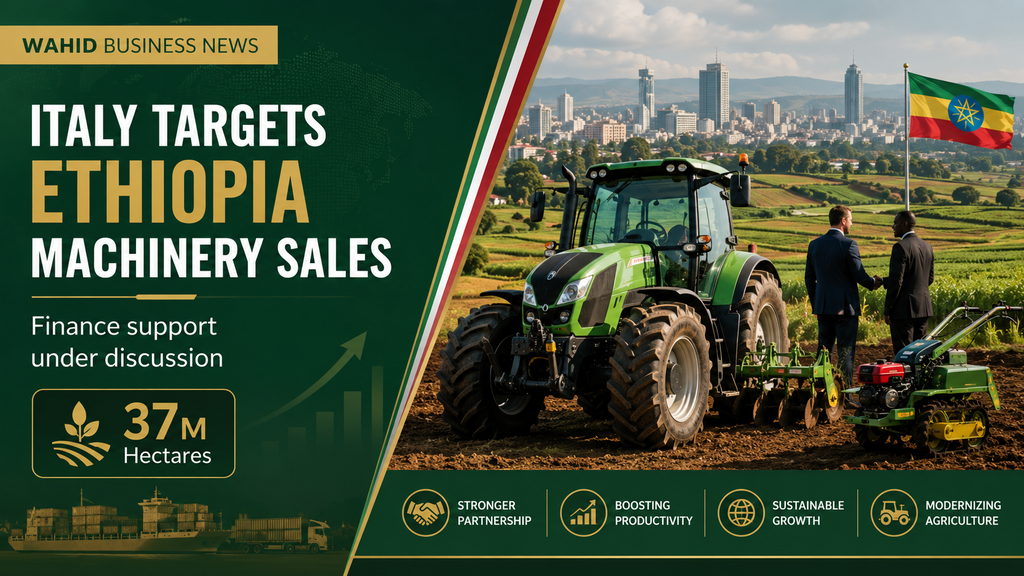
Key Takeaways:
• 37m hectares — Ethiopia’s arable land, with about 16m hectares currently cultivated.
• ECCSA and ICE are linking Ethiopian companies with Italian machinery manufacturers.
• Financing discussions are underway with Italian financial institutions, but no facility is announced.
• EIMA International 2026 will host Ethiopian companies in Bologna from November 10–14.
• 600+ exhibitors from over 100 countries will participate in the machinery exhibition.
• Italy aims to double bilateral trade with Ethiopia within five years.
• Italian manufacturers are considering assembly lines and future manufacturing plants in Ethiopia.
Market Impact:
Affordable credit will determine whether Italian machinery promotion translates into actual equipment sales. Ethiopian businesses face not only import costs but also requirements for spare parts, maintenance, training and reliable after-sales support.
Italy’s equipment offering is aligned with Ethiopia’s smallholder-dominated farming structure, particularly horticulture, cereals, oilseeds and fruit production. The commercial opportunity therefore extends beyond large tractors toward small- and medium-scale machinery suited to varied agro-ecological conditions.
The longer-term investment signal is more significant than the exhibition itself. Assembly and manufacturing in Ethiopia could reduce import dependence, improve servicing capacity and position the country as a machinery supply base for neighbouring markets.
Key Numbers:
37m hectares — Ethiopia’s arable land — agricultural production potential
16m hectares — Land currently cultivated — mechanisation and expansion gap
November 10–14, 2026 — EIMA International dates — machinery sourcing platform
600+ exhibitors — Exhibition participants — supplier breadth
100+ countries — EIMA representation — international market access
5 years — Italy’s trade-doubling target — bilateral commercial ambition
5 pillars — Agriculture’s place in Ethiopia’s reform agenda — policy priority
Business Signal:
Italy is testing whether export finance, machinery sales and eventual local assembly can turn Ethiopia’s mechanisation gap into a long-term industrial partnership.