
Key Takeaways:
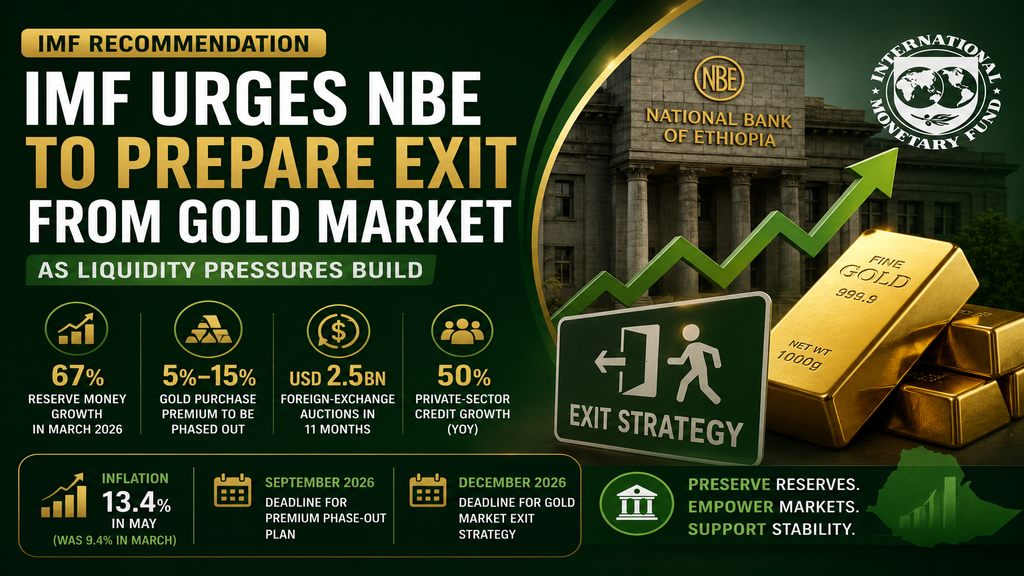
• 67% — Ethiopia’s reserve money growth accelerated year-on-year in March 2026.
• IMF urged NBE to prepare a comprehensive gold-market exit strategy by December 2026.
• 5%–15% — NBE’s premium above international gold prices should be phased out.
• USD 2.5bn — NBE conducted 14 foreign-exchange auctions during the fiscal year’s first eleven months.
• 50% — private-sector credit expanded year-on-year as liquidity pressures intensified.
• 13.4% — inflation rose in May from 9.4% in March.
• NBE’s gold exit could redirect foreign-exchange flows through private-sector market participants.
Market Impact:
The IMF’s recommendation targets a growing monetary-policy conflict. NBE’s birr-funded purchases from artisanal miners support gold exports and reserve accumulation, but they also inject liquidity that the central bank must later absorb through costly open-market operations.
A gradual exit would shift gold purchasing and foreign-exchange intermediation toward private businesses. However, the transition must preserve export volumes and reserve accumulation while avoiding disruption to miners currently receiving a premium above world prices.
The recommendation also raises implications for banks, particularly the Commercial Bank of Ethiopia, through which much of the gold-related liquidity flows. Strong private-sector credit growth and renewed inflation may require additional tightening if price pressures persist.
Key Numbers:
67% — March reserve money growth — gold purchases intensified liquidity creation
43% — February reserve money growth — previous monthly comparison
5%–15% — Gold purchase premium — proposed gradual phase-out
USD 2.5bn — FX auctions over eleven months — foreign currency recycled to businesses
14 — NBE foreign-exchange auctions — market intervention frequency
50% — Private-sector credit growth — liquidity and inflation pressure
10% decline — Credit to state-owned enterprises — changing credit allocation
13.4% — May inflation — renewed price pressure
9.4% — March inflation — pre-rebound comparison
USD 3.4bn — IMF ECF programme — reform framework
September 2026 — Deadline for premium phase-out plan — near-term reform milestone
December 2026 — Deadline for gold-market exit strategy — policy transition target
Business Signal:
The IMF wants Ethiopia to preserve gold-generated foreign exchange while shifting purchasing, pricing and liquidity risks from the central bank toward a market-based private-sector structure.