
1.33bn litres/year — Previously announced second-phase LNG capacity target; coverage under the latest contract remains unspecified.
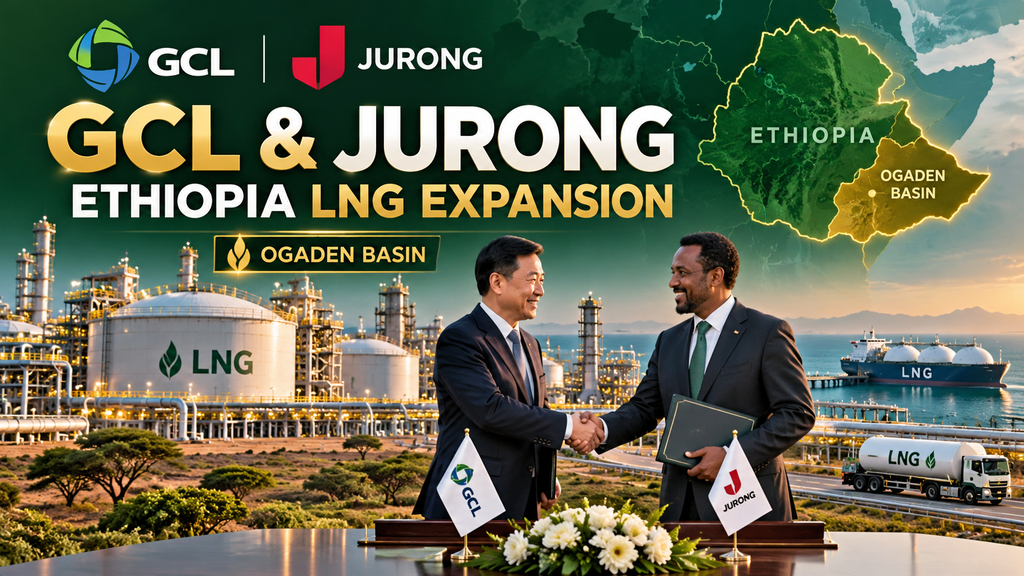
October 16, 2026 — GCL Group and Jurong Group signed a construction and gas-processing agreement at Ethiopia’s Ministry of Mines.
Calub gas field — The contract covers second-phase liquefaction facilities, engineering, construction and processing services in Somali Region.
200,000 m³/day — First-phase gas-processing capacity commissioned in October 2025, with annual LNG capacity of approximately 50,000 tonnes.
International exports — GCL and Jurong plan LNG storage, transportation and trading infrastructure, with export destinations still unconfirmed.
USD 4.2bn — Separate GCL–Dangote gas supply agreement supports a proposed fertiliser complex in Gode.
Project financing — Contract value, additional production capacity, financing arrangements and completion deadlines remain undisclosed.
Market Impact
Energy infrastructure: The agreement advances Ethiopia’s second-phase LNG development beyond the earlier cooperation framework by defining construction and processing responsibilities. The Ministry of Mines has requested the first expansion module to begin construction as soon as possible.
Transport and logistics: Expanded LNG production could support natural-gas use in domestic transportation and industry. International exports would require specialised storage, distribution and transport infrastructure, with Djibouti previously identified as a potential export route.
Industrial development: Development of Calub's natural gas resources could support domestic manufacturing and fertiliser production. A separate 25-year GCL–Dangote supply agreement provides for gas deliveries through a planned 108-kilometre pipeline to a proposed fertiliser facility in Gode.
Foreign exchange and investment: Commercial LNG exports could diversify Ethiopia’s foreign-currency earnings beyond agricultural commodities and minerals. Realising these benefits will depend on project financing, operational capacity, export logistics and future sales contracts.
Implementation uncertainty: The agreement establishes more specific project responsibilities but does not confirm the scale of the contracted expansion, construction timetable or binding export arrangements.
Key Numbers
October 16, 2026 — Second-phase agreement signed — construction and processing cooperation milestone.
October 2, 2025 — First LNG module commissioned — initial operational milestone.
200,000 m³/day — First-phase natural gas processing capacity — existing design baseline.
50,000 tonnes/year — First-phase LNG production capacity — existing design capacity.
1.33bn litres/year — Previously announced second-phase LNG capacity target — proposed expansion scale, not confirmed contract scope.
USD 4.2bn — Separate GCL–Dangote natural gas supply agreement — planned industrial feedstock commitment.
25 years — GCL–Dangote gas supply agreement duration — long-term industrial supply arrangement.
108 km — Planned gas pipeline from Calub to Gode — fertiliser supply infrastructure.
3m tonnes/year — Proposed Gode fertiliser plant's urea production capacity — domestic manufacturing target.
Business Signal
GCL and Jurong are advancing Ethiopia’s LNG industry toward expanded processing, industrial gas supply and potential exports, although financing, production scale and international logistics arrangements remain unconfirmed.