
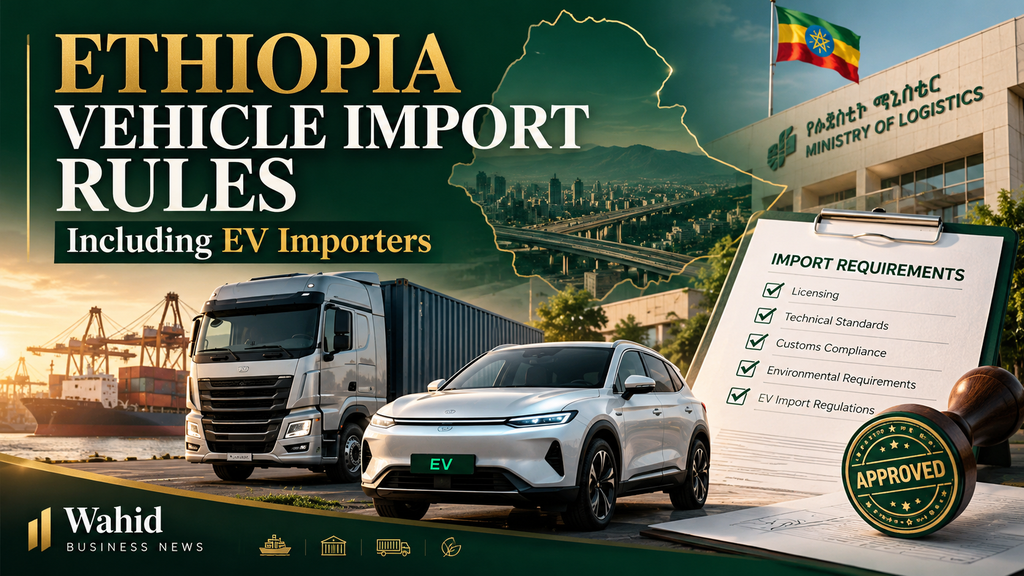
Importers must meet Ministry of Transport and Logistics qualification requirements covering business documentation, technical standards, repair facilities, spare parts, warranties and after-sales services.
Introduction
Importing vehicles into Ethiopia involves more than obtaining a trade licence and arranging international shipment. Businesses importing medium- and heavy-duty vehicles must satisfy technical, organisational and after-sales service requirements before receiving a Vehicle Import Qualification Certificate from the Ministry of Transport and Logistics.
The requirements establish obligations covering the importer's legal identity, manufacturer authorisation, technical capacity, workshop facilities, spare parts availability, vehicle standards and consumer protection.
For companies importing electric commercial vehicles, the framework is particularly relevant because it also addresses vehicles equipped with new technologies, including obligations to provide technical information, safety guidance and training.
The requirements outlined below are drawn from a vehicle-import qualification document covering medium- and heavy-duty vehicles. Their application to electric passenger cars or other light-duty vehicles must be separately confirmed with the Ministry.
1. Vehicle Import Qualification Certificate
Under the supplied procedure, businesses importing medium- and heavy-duty vehicles must obtain a Vehicle Import Qualification Certificate issued by the Ministry of Transport and Logistics.
The Ministry issues the certificate after reviewing and verifying compliance with the prescribed requirements.
The qualification process assesses not only the importer's legal and commercial documents but also its facilities, technical personnel and ability to maintain the vehicles it imports.
The document expressly excludes commission agents from this procedure. Businesses operating through commission or intermediary arrangements should therefore clarify their applicable regulatory obligations before relying on this qualification framework.
2. Business Registration and Documentation Requirements
Applicants must submit an application containing the name of the company owner or manager and the company's full address, including the relevant administrative divisions and contact details.
The required supporting documentation includes:
A national digital identification document for the owner or manager.
Two recent passport-sized colour photographs taken within the preceding six months.
A renewed Kebele identification card or other legally acceptable proof of identity.
Business registration documentation for vehicle import activities.
A Taxpayer Identification Number (TIN) certificate.
Documents establishing ownership or lawful occupancy of the company's offices, warehouse and other relevant premises.
A valid lease agreement certified by the competent document authentication and registration service where premises are rented.
Manufacturer authorisation or other qualifying representation and trade documentation specified by the procedure.
Where relevant documents originate outside Ethiopia, the procedure also provides for authentication through Ethiopia's Ministry of Foreign Affairs.
Importers should ensure that their supporting documentation is consistent with their registered business activities and the vehicle brands they intend to represent.
3. Manufacturer Authorisation and Technical Documentation
The qualification requirements place importance on the relationship between the importer and the vehicle manufacturer or authorized representative.
Applicants must provide the chamberized manufacturer authorization.
Vehicle technical specifications must also be prepared and documented in English.
Additionally, the importer must provide original Road Worthiness Inspection Certificate for the vehicles it imports, battery certification if it is for EV.
These requirements make technical documentation an essential component of the import qualification process rather than merely a commercial formality.
4. Compliance With Ethiopian Vehicle Standards
Vehicles imported under the documented framework must comply with Ethiopian national vehicle standard ES7087:2024 (you can get this standard document from IES paying some money)
Importers are responsible for ensuring that the vehicles they bring into the country meet the applicable national standards.
The supplied procedure identifies the standard but does not reproduce its technical specifications or explain its coverage by vehicle class or propulsion system.
Consequently, importers should obtain and review the relevant standard and confirm the applicable conformity assessment requirements before committing to vehicle procurement.
5. Mandatory Repair Garage and After-Sales Facilities
One of the most significant obligations is the requirement for importers to maintain their own comprehensive repair facilities for the medium- and heavy-duty vehicles they import and sell.
The document sets out several minimum workshop and service-facility requirements.
Repair and maintenance facilities
The garage must provide:
Repair space sufficient for at least three vehicles, depending on vehicle type.
Parking space sufficient for at least three vehicles.
A minimum 60-square-metre area where different repairs can be performed.
At least one vehicle repair pit.
A washing area sufficient for at least one vehicle.
Adequate vehicle entry and exit arrangements.
Changing facilities, a bathroom and a toilet.
These are documented facility requirements, not necessarily the complete technical specifications needed for every vehicle category.
Spare parts warehouse
The importer must also establish a spare parts storage facility measuring at least 4 metres by 6 metres, equivalent to 24 square metres.
The warehouse must have appropriate shelving separated from the service counter to facilitate storage and handling.
Beyond physical storage, importers must maintain sufficient and reliable spare parts for the vehicles they import.
The document does not prescribe a minimum spare parts inventory value, stock turnover period or brand-specific list of replacement components.
6. Office, Personnel and Showroom Requirements
Vehicle importing companies must establish an operational organisation capable of handling commercial, administrative and technical responsibilities.
The procedure identifies six functional office areas:
Operations.
Secretary and reception.
Vehicle and spare parts sales.
Accounting and administration.
Quality and control.
Technical maintenance and training.
The required offices and work areas must be organised adequately for their intended functions.
Vehicle display and parking
For vehicles assembled or partially assembled in Ethiopia, the document specifies space for at least three display vehicles and two parking spaces.
It also states that access from a main road should have a width of at least six metres and a gravel surface.
Importers should confirm how the relevant facility and display provisions apply to their particular vehicle categories and business premises.
7. Requirements Relevant to Electric Vehicle Importers
Electric vehicle importation introduces additional technical considerations because the vehicles rely on electrical propulsion systems and technologies that differ from conventional internal-combustion vehicles.
The supplied procedure requires importers of vehicles equipped with new technologies to inform customers and relevant authorities about associated safety precautions.
It also establishes obligations concerning technical training, fault monitoring, consumer information and after-sales services.
For businesses importing electric medium- and heavy-duty vehicles, these requirements are relevant when organising their technical support operations.
However, the document does not separately specify minimum EV charging infrastructure, high-voltage workshop equipment, battery-handling procedures, technician certification requirements or EV-specific warehouse arrangements.
Nor does it establish whether the same qualification process applies to electric passenger cars.
These matters require confirmation under the applicable vehicle-category standards and Ministry procedures.
8. Warranty and Consumer Protection Obligations
Importers must provide warranties for the vehicles they bring into Ethiopia.
They must also supply customers with the appropriate vehicle documentation at the time of sale and during after-sales service.
The document requires importers to collect information about technical problems encountered during vehicle operation.
When faults are identified, importers must document their causes and solutions and incorporate the findings into relevant technical training.
The supplied procedure does not specify a minimum warranty duration, warranty mileage or separate battery warranty requirements.
Importers should therefore distinguish the general obligation to provide a warranty from the specific contractual coverage offered by each manufacturer.
9. Technical Training and Reporting Obligations
Vehicle importers have continuing responsibilities after receiving import qualification.
They must provide on-the-job training on imported vehicle technologies to relevant authorities and promote technical knowledge through appropriate channels.
The procedure also requires importers to organise training at least once annually, in accordance with Ministry guidelines and in collaboration with the authorised company.
Importers must submit reports to the Ministry of Transport and Logistics every three months covering training provided and information about imported vehicles.
These requirements make staff training, technical records and reporting part of the importer's continuing compliance obligations.
For electric commercial vehicle importers, the framework reinforces the importance of establishing dependable technical expertise rather than relying exclusively on vehicle sales.
10. Practical Implications for Vehicle Importers and Investors
The documented qualification framework has several commercial implications.
First, vehicle importation requires an operating infrastructure. Companies must plan for offices, repair facilities, spare parts storage, vehicle display space and appropriately organised personnel.
Second, manufacturer support is important. Access to technical documentation, spare parts, training and warranty support can influence an importer's ability to meet the qualification requirements.
Third, after-sales service is a regulatory responsibility. Importers must maintain vehicles, provide warranties and documentation, monitor technical defects and communicate relevant safety information.
Fourth, compliance continues after qualification. Annual training, quarterly reporting and ongoing conformity with vehicle standards require sustained management attention.
Fifth, vehicle classification matters. Businesses dealing in passenger cars, light-duty vehicles, electric buses, electric trucks or other specialised vehicles should confirm the precise requirements applicable to each category.
11. What Traders Should Verify Before Importing
Before committing funds to an overseas manufacturer or arranging vehicle shipments, traders should verify three regulatory matters.
The first is whether their intended vehicle category falls within the Ministry's qualification procedure and which national technical standards apply.
The second is whether their physical premises, manufacturer documentation, service capacity and spare parts arrangements satisfy the requirements for obtaining the Vehicle Import Qualification Certificate.
The third is whether additional import permissions, customs requirements, vehicle registration rules or propulsion-specific conditions apply. These matters are not comprehensively addressed in the supplied qualification document.
The procedure also does not establish import duty rates, tax exemptions, financing requirements, electric passenger vehicle eligibility or a timetable for processing qualification applications.
Importers should obtain confirmation of these matters from the relevant authorities rather than treating the qualification document as a complete customs and import manual.
Conclusion
Ethiopia's documented medium- and heavy-duty vehicle import qualification requirements place substantial emphasis on importer competence, technical standards, workshop infrastructure, spare parts availability and consumer protection.
For established vehicle dealers, manufacturers' representatives and prospective market entrants, compliance therefore extends beyond securing a commercial licence or an international supply agreement.
Companies must demonstrate an operational capacity to sell, support and maintain the vehicles they introduce into the Ethiopian market.
As electric and other new vehicle technologies become more common, the requirements concerning technical training, safety information, warranties and after-sales support will remain important considerations for importers.
Business Signal
Ethiopia's vehicle import qualification framework makes technical capacity and after-sales infrastructure central to market participation, requiring traders to assess compliance costs alongside vehicle procurement and sales opportunities.
If you want to download and read the whole document in Amharic: click this link https://wahidbusinessnews.com/admin-dashboard/admin_app/resourcesmodel/20/change/