
Key Takeaways:
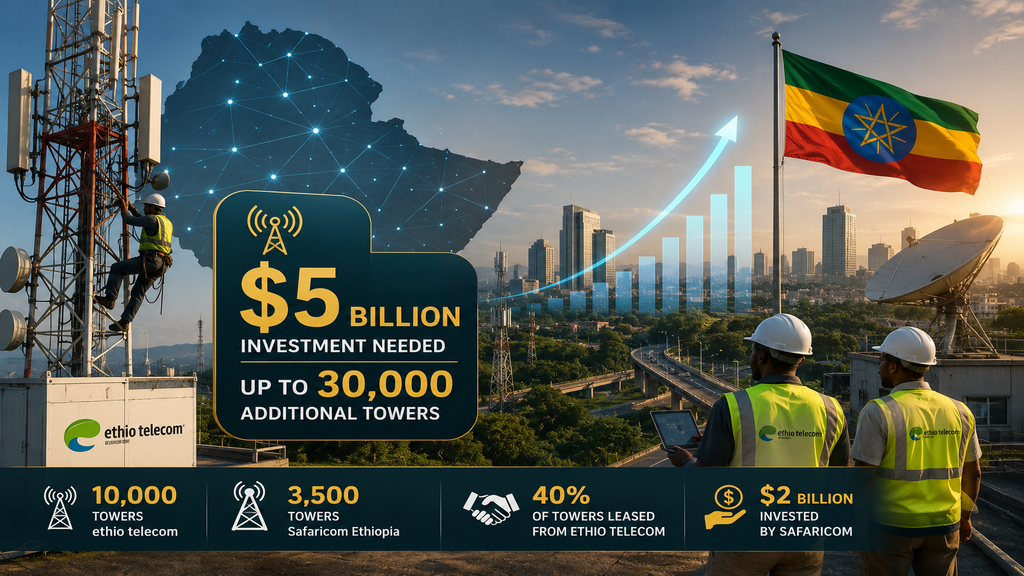
• $5bn in additional investment is needed to improve Ethiopia’s telecom competitiveness.
• Andualem Admassie said Ethiopia needs up to 30,000 additional telecom towers.
• Ethio telecom has around 10,000 towers, while Safaricom Ethiopia has 3,500.
• Safaricom leased 40% of its towers from ethio telecom and built the rest.
• Safaricom Ethiopia invested about $2bn in operations, excluding licence payments.
• Safaricom paid $850mn for its telecom permit and $150mn for its M-Pesa licence.
• A third telecom operator and separate infrastructure licensing could improve sector competition.
Market Impact:
Ethiopia’s telecom market remains constrained by infrastructure gaps, with fewer than 15,000 towers shared between ethio telecom and Safaricom Ethiopia. Andualem Admassie argues that meeting Digital Ethiopia 2030 targets requires major tower expansion and stronger public-private investment coordination.
The proposal to allow separate telecom infrastructure companies would shift tower development away from operators and create a new investment segment. It could also allow operators such as ethio telecom and Safaricom Ethiopia to focus more on service delivery than infrastructure construction.
The call for a third operator points to continued pressure for deeper telecom liberalisation. For investors, tower developers and digital-service firms, the sector’s next opening may depend on infrastructure licensing, regulatory neutrality and capital mobilisation.
Key Numbers:
$5bn — additional telecom investment needed — infrastructure expansion requirement
30,000 — additional towers needed — Digital Ethiopia 2030 infrastructure gap
10,000 — ethio telecom towers — incumbent infrastructure base
3,500 — Safaricom Ethiopia towers — second-operator network base
40% — Safaricom towers leased from ethio telecom — infrastructure-sharing indicator
$2bn — Safaricom operational investment — capital already deployed
Br12bn — Safaricom tax payment over three years — fiscal contribution
Business Signal:
Ethiopia’s telecom market needs large-scale infrastructure investment, separate tower licensing and more competition to support digital economy targets.