
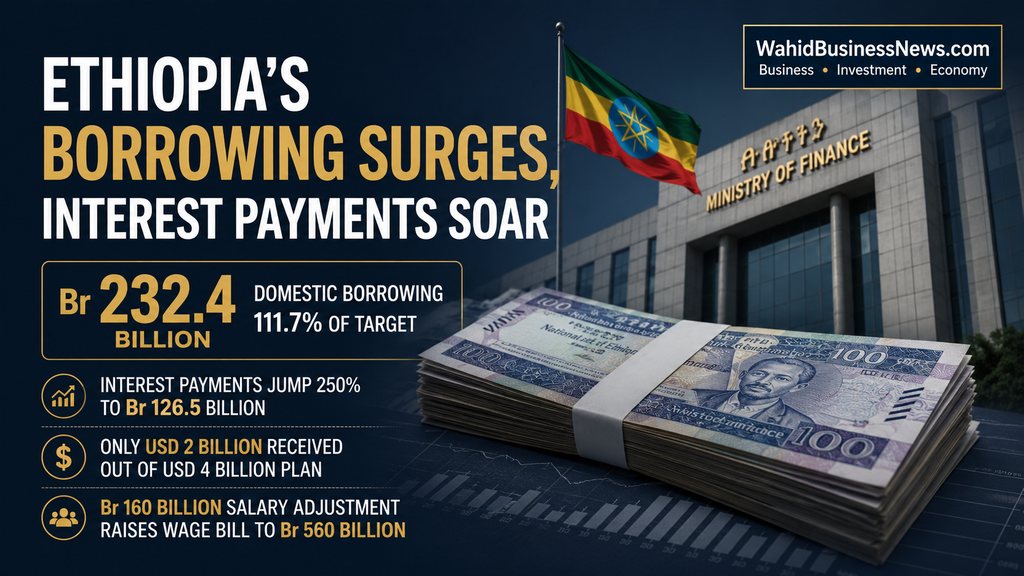
- Finance Minister Ahmed Shide told Parliament that domestic borrowing reached Birr 232.4 billion, 111.7 % of its nine-month target, as foreign financing arrived late.
- Market-based Treasury bills pushed domestic interest payments up 250 % to Birr 126.5 billion, and only half of the planned USD 4 billion in external financing was disbursed.
- A Br 160 billion salary adjustment raised the annual civil-service wage bill to Br 560 billion.
Market Impact:
Heavy domestic borrowing and rising interest payments could crowd out private-sector credit and fuel inflation. Delayed external aid strains the budget and may force the government to cut spending or seek new revenue sources.
Key Numbers:
- Br 232.4 billion — domestic borrowing to date.
- 111.7 % — proportion of nine-month borrowing target achieved.
- Br 126.5 billion — interest payments on Treasury bills.
- Br 160 billion — civil-service salary adjustment.
- USD 4 billion / USD 2 billion — planned vs. received external financing.
Business Signal:
The reliance on domestic financing signals tightening fiscal conditions that could lead to higher borrowing costs and reduced liquidity for private firms.